
Sustaining Undergraduate STEM Transformation And Improvement Networks through Change Agent Turnover
The goal of this IUSE Track 1 Institutional and Community Transformation grant, SUSTAIN-CAT is to better understand how STEM educational change networks sustain themselves and their efforts when people leave or shift roles (i.e., change agent turnover; CAT).
Objectives
Objective 1
Leverage existing data and expert feedback to identify processes, structures, relationships, and states that support the sustainability of change efforts beyond CAT
Analysis of secondary data from five existing, NSF-funded change projects (collectively representing 118 STEM education change teams) will inform and augment current change theories in STEM education, specifically by providing insight into the phenomenon of CAT. Experienced change agents will contribute to theory-building about strategies to sustain or expand change efforts through CAT, by participating in a modified Delphi process.
Objective 2
Develop, pilot, and refine an interactive toolkit to support change agent teams in proactively planning for sustainability beyond CAT.
The vignettes will be included in an interactive toolkit and accompanying workshops focused on supporting change agent teams through CAT. Change agent teams will pilot this toolkit and engage in a series of workshops to support their use of the toolkit. Results from this pilot stage will support revisions to the toolkit, which will then be shared broadly.
Objective 3
Understand how interactions with the toolkit influence processes, structures, relationships, and states of teams experiencing CAT.
Collection and analysis of data from change agent teams piloting the toolkit will inform the development of theory about CAT. Findings related to toolkit implementation will be shared with both researcher and practitioner audiences through presentations at relevant conferences and manuscripts (both practical and theory-extending).
Institutional and Community Transformation projects depend on a core group of change agents to provide leadership and momentum for the project. Peripheral people are also involved (department chairs, deans, other partners), whose positional power can positively or negatively impact project progress. One constant is that across a multi-year project, the people involved change. This project will contribute to understanding how change processes are sustained through CAT, as well as best practices for onboarding and enculturating new personnel who can help to sustain and transform change efforts. Despite numerous efforts to transform STEM education, most change efforts fail. Higher education faculty rarely have training on how to handle changes in project personnel, document “institutional knowledge” of projects, or onboard new members authentically. Turnover is impacted by leadership structures (e.g., distributed vs. centralized leadership structures) and the extent to which teams share a common vision for change. More research is needed to understand the relationship between change team structures, processes to develop a shared vision for change, and CAT. This proposed grant will build off of best practices for onboarding new change agents and weathering CAT, by examining data from five projects: 3 IUSE grants, 1 ECR grant, and 1 S-STEM hub (involving 8 S-STEM projects).
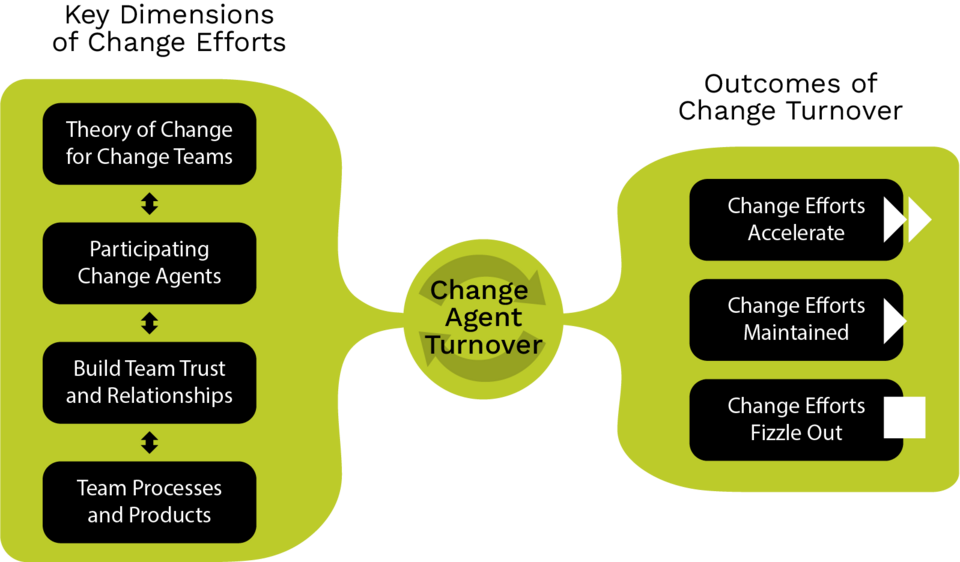
How do institutional and community transformation projects sustain their critical change efforts through personnel turnover, while also honoring and incorporating the strengths and interests of incoming change team members?
Primary Research Question
Broader Impacts
This project will focus on practitioner-oriented research, with change teams applying the CAT Toolkit to help sustain and even accelerate change efforts through turnover in change agents. Deliverables from the project will be broadly useful for IUSE-ICT projects and other change efforts. The five projects from which change teams will be recruited represent a broad span of STEM education research efforts, from preservice teacher preparation, to improving the transfer experience for undergraduates, to improving undergraduate STEM teaching and learning. The involved change teams span small groups of volunteers within one STEM department to large statewide efforts involving 20 or more educational institutions (PK-12, associate-degree granting, bachelor-degree granting, masters-degree granting, and doctoral-degree granting). Although change efforts are local, context dependent, and individualized for particular goals, teams, and situations, all change teams inevitably encounter CAT; failing to accommodate CAT typically results in change efforts fizzling out. Change teams that proactively plan for accommodating CAT are much better positioned to weather the changes and even use the CAT to accelerate or broaden their change efforts.
Publications
- Bennett, A. B., Smith, W. M., & Funk, R. (2026). Expand, maintain, or fizzle? How to sustain institutional change efforts in STEM throughout personnel turnover. AAAS IUSE Blog.
- Smith, W. M. (November, 2025). MTEP 2.0 NIC-Cast synthesis: How NICs handle turnover. MTEP Transformers.
Research Team

Amy Bennett
Principal Investigator
Wendy Smith
Co-Principal Investigator

Rachel Funk
Co-Principal Investigator

Leilani Pai
Researcher

Molly Williams
Researcher

Katie Wilson
Researcher

Camilla Ramos de Matos Carvalho Morone
Project Manager

This project is funded by a grant from the National Science Foundation (Award #2518434). Any opinions, findings and conclusions or recommendations expressed in this material are those of the author(s) and do not necessarily reflect the views of the National Science Foundation.